
Table of Contents
Introduction: Why DevOps Pipelines Matter in Canada
The technology ecosystem in Canada is evolving at lightning speed. From fintech startups in Toronto to AI-driven healthcare companies in Vancouver, Canadian businesses are under pressure to deliver software faster, safer, and more reliably. This is where DevOps pipelines play a crucial role.
A DevOps pipeline is more than just automation—it’s a cultural and technological shift that helps organizations streamline software development, deployment, and monitoring. If you’ve ever wondered, “What is DevOps, and why does it matter for Canadian businesses?”, the answer is simple: it’s the backbone of modern product delivery.
By leveraging DevOps services in Canada, businesses can align development and operations teams, reduce downtime, and deploy products to market much faster. This isn’t just a technical upgrade—it’s a business necessity in today’s digital-first economy.
What is a DevOps Pipeline?
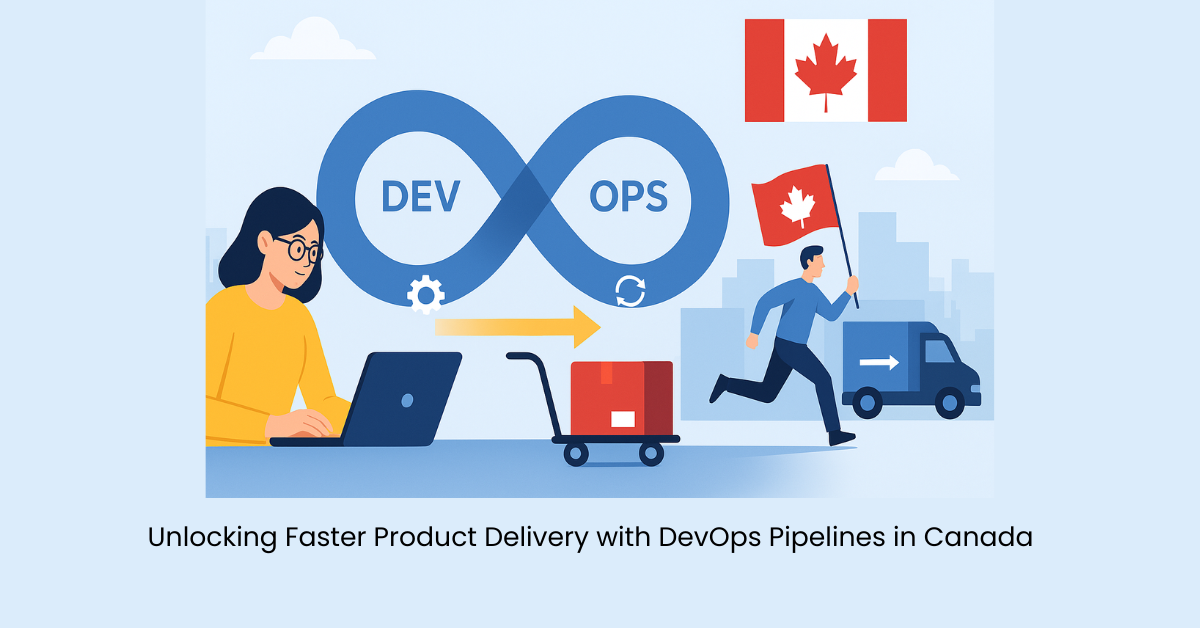
At its core, a DevOps pipeline is a set of automated processes and tools that allow developers and IT operations teams to collaborate and deliver software more efficiently. Instead of waiting weeks or months to launch updates, pipelines ensure continuous integration (CI) and continuous delivery (CD).
A typical DevOps pipeline in Canada—or anywhere else—includes:
- Code Commit → Developers push code to a version control system like Git.
- Build & Test Automation → Automated testing ensures code quality and security.
- Continuous Integration (CI) → Integrates code changes into a shared repository.
- Continuous Delivery/Deployment (CD) → Delivers code to staging or production environments automatically.
- Monitoring & Feedback → Real-time monitoring tools provide insights into performance and security.
This automation reduces human error, accelerates deployment cycles, and improves collaboration across teams.
The Growing Demand for DevOps in Canada
Why is Canada seeing such rapid adoption of DevOps pipelines? The reasons are both technical and economic:
- Startup Boom: Cities like Toronto, Montreal, and Vancouver are global tech hubs. Startups need fast product delivery to compete internationally.
- Cloud Migration: More Canadian companies are shifting workloads to Microsoft Azure Canada, AWS Canada (Montreal & Calgary regions), and Google Cloud Canada. DevOps pipelines naturally integrate with these platforms.
- Remote Work: Distributed teams across provinces—from Ontario to British Columbia—need reliable collaboration tools and automated workflows.
- Regulatory Compliance: Financial and healthcare institutions require secure, auditable, and repeatable deployment processes.
Whether it’s DevOps services in Dubai, the U.S., or here in Canada, the principles are the same. But Canadian businesses must adapt to local compliance and infrastructure requirements.
Benefits of DevOps Pipelines for Canadian Businesses
Let’s break down how DevOps pipelines unlock faster product delivery and better outcomes:
1. Accelerated Time-to-Market
Traditional release cycles can take weeks or months. DevOps pipelines shrink this to days—or even hours. For example, an e-commerce company in Toronto can push daily feature updates without downtime.
2. Improved Collaboration
DevOps fosters a culture where developers, QA engineers, and operations teams work together. This reduces silos, leading to faster resolution of issues.
3. Enhanced Security
Security isn’t an afterthought anymore. With DevSecOps practices, pipelines automatically scan for vulnerabilities before deployment. This is critical for industries like fintech and healthcare.
4. Scalability and Flexibility
Businesses in Canada often experience seasonal or regional demand spikes. Automated pipelines on Azure Canada Central or AWS Canada East (Montreal) allow scaling infrastructure without downtime.
5. Cost Efficiency
By automating repetitive tasks, companies reduce manual labor costs and avoid expensive downtime.
6. Customer Satisfaction
Ultimately, faster and more reliable product delivery means happier customers. Whether it’s a banking app in Calgary or a SaaS product in Vancouver, end-users get seamless updates.
Building a Modern DevOps Pipeline in Canada
If you’re considering implementing DevOps services in Canada, here are the steps to building an effective pipeline:
Step 1: Assess Current Infrastructure
Start by analyzing existing workflows, tools, and bottlenecks. Are deployments taking too long? Are there frequent bugs in production?
Step 2: Choose the Right Tools
Popular DevOps pipeline tools include:
- CI/CD: Jenkins, GitLab CI, GitHub Actions, Azure DevOps
- Containerization: Docker, Kubernetes (with Canadian hosting options)
- Monitoring: Prometheus, Grafana, Datadog
- Security: SonarQube, Snyk, HashiCorp Vault
Step 3: Integrate Cloud Platforms
Canadian organizations often choose AWS Canada, Google Cloud Canada, or Microsoft Azure Canada regions to stay compliant with data residency laws.
Step 4: Automate Testing
Include unit testing, integration testing, and security scans in the pipeline. Automation ensures faster feedback loops.
Step 5: Enable Continuous Monitoring
Use observability tools that provide real-time insights. Alerts help resolve issues before they impact end-users.
Step 6: Cultural Shift
Technology alone won’t deliver results. Train teams, encourage collaboration, and embrace a “fail fast, fix faster” mindset.
Real-World Example: DevOps Pipelines in Canadian Fintech
Take the example of a fintech company in Montreal. By implementing an automated DevOps pipeline with Azure DevOps and Kubernetes, they reduced their deployment time from two weeks to just two days.
Security scans were automated at each stage, ensuring compliance with PCI-DSS standards. This enabled them to scale globally while staying compliant with Canadian regulations.
Similar success stories can be seen in healthcare, SaaS, and government sectors, proving that DevOps pipelines aren’t just a trend—they’re a competitive advantage.
Future of DevOps in Canada
As AI, machine learning, and edge computing expand across Canada, DevOps will become even more critical. Pipelines will integrate AI-driven testing, predictive monitoring, and self-healing infrastructure.
In the near future, Canadian businesses will see:
- AI-powered CI/CD to detect bugs before humans do.
- Serverless DevOps pipelines for cost efficiency.
- Global collaboration tools enabling cross-border teams to deliver faster.
Conclusion
Unlocking faster product delivery isn’t about cutting corners—it’s about building smarter, automated, and resilient pipelines. For Canadian businesses, DevOps pipelines are no longer optional; they are essential for growth, innovation, and competitiveness.
Whether you’re a fintech startup in Toronto, a healthcare company in Vancouver, or a SaaS provider in Calgary, adopting DevOps practices will help you deliver products faster, safer, and smarter.
If you’re ready to accelerate your product delivery, consider partnering with experts who specialize in DevOps services in Canada—because in today’s world, speed is the new currency.
Frequently Asked Questions
What is a DevOps pipeline?
A DevOps pipeline is an automated workflow that moves software from development to production. It includes coding, building, testing, deploying, and monitoring, ensuring faster and more reliable delivery.
Why are DevOps pipelines important for Canadian businesses?
They help Canadian organizations accelerate software delivery while meeting compliance (PIPEDA, PCI DSS), addressing data sovereignty, and ensuring security and customer satisfaction.
Do DevOps pipelines help with compliance in Canada?
Yes. Automated compliance checks for PIPEDA, PCI DSS, and HIPAA can be integrated into CI/CD workflows, ensuring every release meets Canadian regulatory standards before deployment.
What is the future of DevOps pipelines in Canada?
The future lies in AI-driven, self-healing pipelines with compliance automation, supporting faster digital transformation across industries as Canadian cloud regions expand.