
Table of Contents
Introduction
Scaling a SaaS platform is not just about adding servers it requires automation, reliability, and speed.
A Toronto-based SaaS company approached Geeks Solutions Canada with a critical challenge:
Their infrastructure could not keep up with rapid growth and increasing user demand.
Frequent deployment delays, inconsistent environments, and performance issues were slowing down innovation.
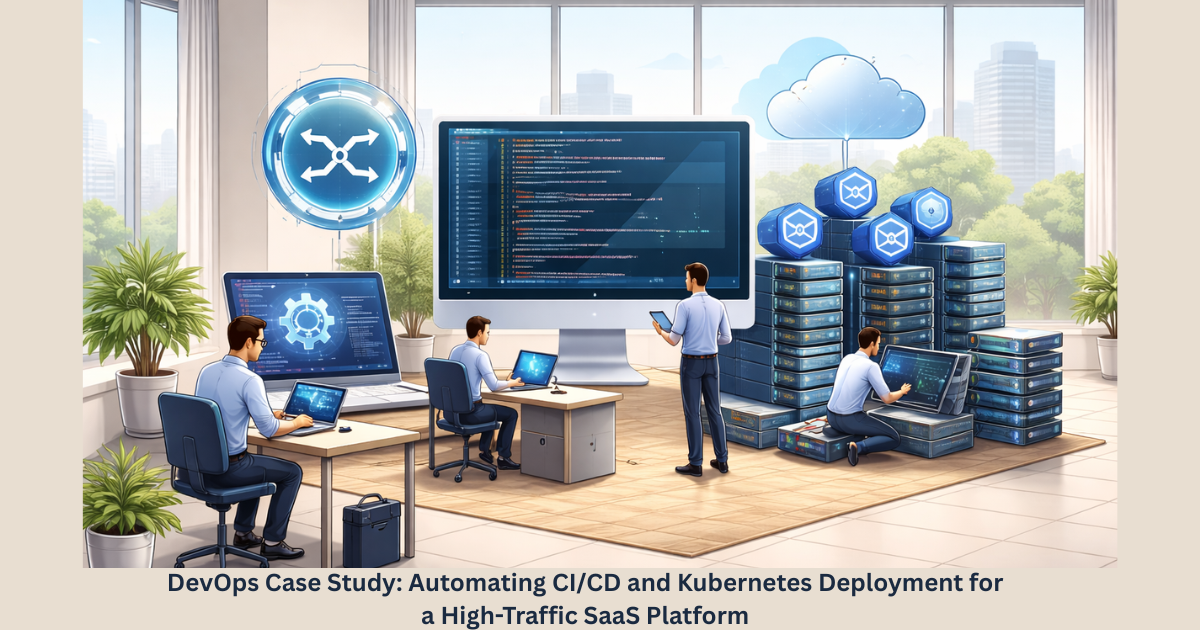
In this case study, we show how implementing CI/CD pipelines and Kubernetes orchestration transformed their infrastructure, reducing deployment time by over 90% and enabling seamless scalability.
Client Overview
The client is a customer analytics SaaS platform serving thousands of businesses across Canada and North America.
Platform Characteristics:
- Processes millions of user events daily
- Handles real-time API requests
- Built on microservices architecture
- Uses PostgreSQL databases
Challenges Faced
1. Slow & Risky Deployments
Deployments were manual and time-consuming:
- Average release time: ~2 hours
- High dependency on engineers
- Frequent deployment errors
2. Environment Inconsistencies
Different configurations across environments caused:
- “Works in staging, fails in production” issues
- Dependency conflicts
- Debugging delays
3. Scalability Bottlenecks
During peak traffic:
- API failures increased
- Response time slowed down
- System outages occurred
No auto-scaling = poor user experience
4. Lack of CI/CD Automation
No structured pipeline for:
- Automated testing
- Build validation
- Deployment
Result: Slow releases + high risk
DevOps Transformation Strategy
Geeks Solutions implemented a modern DevOps architecture focused on:
- Kubernetes orchestration
- CI/CD automation
- Infrastructure as Code (IaC)
- Real-time monitoring
Kubernetes Implementation
Containerization with Docker
Applications were packaged into containers to ensure:
- Consistent environments
- Faster deployments
- Easy portability
Kubernetes Cluster Setup
A scalable cluster was deployed with:
- Multi-node architecture
- Load balancing
- Auto-scaling enabled
- High availability setup
Real Impact Example
During a traffic spike:
- API requests increased by 300%
- Kubernetes auto-scaled pods instantly
- Load was distributed without downtime
Result: Zero performance degradation
CI/CD Pipeline Automation
A fully automated pipeline was built to streamline delivery.
Continuous Integration:
- Automated testing on every commit
- Security checks
- Docker image creation
Continuous Deployment:
- Automatic deployment to Kubernetes
- Rolling updates
- Zero-downtime releases
- Instant rollback on failure
Deployment time reduced from 2 hours → under 10 minutes
Infrastructure as Code (IaC)
Infrastructure provisioning was automated using code.
Benefits:
- Environment setup in minutes
- No configuration drift
- Faster disaster recovery
Monitoring & Observability
A centralized monitoring system provided insights into:
- Application performance
- Resource utilization
- API response time
- Container health
Real-time alerts improved incident response time significantly
Security Enhancements
Security was integrated into the DevOps pipeline:
- Container vulnerability scanning
- Secure secrets management
- Role-based access control
- Network security policies
Implementation Timeline
The complete transformation was delivered in 8 weeks:
- Week 1–3: Containerization & Kubernetes setup
- Week 4–5: CI/CD pipeline implementation
- Week 6–8: Monitoring, optimization & scaling
Results & Business Impact
Deployment Speed
- Reduced from 2 hours → 10 minutes
Scalability
- Handled 300% traffic spikes automatically
Reliability
- Achieved 99.99% uptime
Release Velocity
- Deployment frequency increased 3X
Efficiency
- Reduced infrastructure overhead and manual effort
Why This Matters for SaaS Companies
For growing SaaS platforms, DevOps is no longer optional.
To stay competitive, companies must:
- Deploy faster
- Scale instantly
- Maintain high availability
This is exactly what Kubernetes + CI/CD enables.
How Geeks Solutions Helps
Geeks Solutions Canada specializes in:
- DevOps consulting
- Kubernetes deployment
- CI/CD pipeline automation
- Cloud infrastructure optimization
We help SaaS companies build scalable, secure, and high-performance systems.
Call to Action
Still struggling with slow deployments or scaling issues?
Let our DevOps experts help you build a modern, automated infrastructure.
Frequently Asked Questions:
1. What is a DevOps case study?
A real-world example showing how DevOps improves deployment speed, scalability, and system reliability.
2. Why use Kubernetes in DevOps?
It automates deployment, scaling, and management of containerized applications.
3. What is CI/CD?
A process that automates testing, building, and deployment of applications.
4. How long does DevOps implementation take?
Typically 6–12 weeks, depending on complexity.