
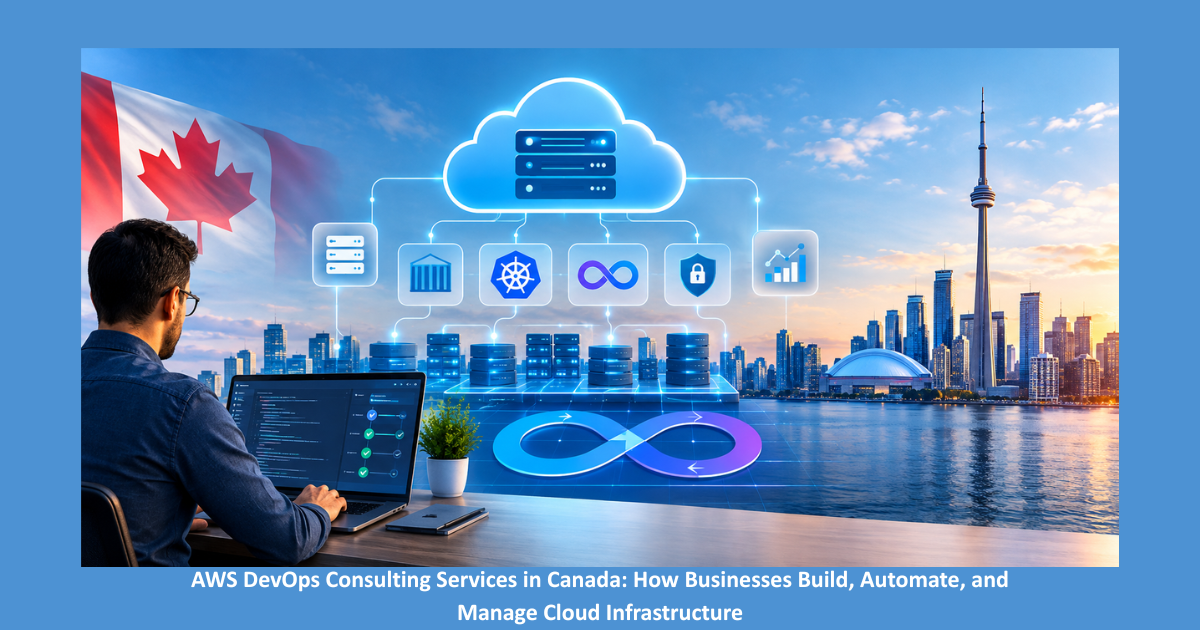
Cloud infrastructure can scale quickly but without the right architecture, automation, security, and cost controls, AWS environments can become difficult and expensive to manage.
AWS cloud consulting services help businesses design, migrate, optimize, secure, and manage AWS infrastructure, while DevOps practices automate software delivery and infrastructure operations. Together, AWS and DevOps can create cloud environments that are more scalable, observable, secure, and easier to operate.
For Canadian businesses modernizing applications, migrating workloads, or adopting cloud-native technologies, combining AWS Canada, DevOps automation, infrastructure as code, and managed cloud operations can provide a practical path toward reliable cloud infrastructure.
What Are AWS Cloud Consulting Services?
AWS cloud consulting services cover the planning, implementation, optimization, and ongoing management of workloads running on Amazon Web Services.
A typical engagement may include:
- AWS infrastructure assessment
- Cloud architecture and Well-Architected reviews
- AWS migration and modernization
- EC2, VPC, RDS, S3, and other AWS service implementation
- CI/CD pipeline automation
- Infrastructure as Code with Terraform
- Kubernetes and Amazon EKS deployment
- Cloud security and monitoring
- AWS cost optimization
- 24/7 cloud and infrastructure management
AWS’s Well-Architected Framework evaluates cloud workloads across six pillars: operational excellence, security, reliability, performance efficiency, cost optimization, and sustainability.
This gives businesses a structured way to identify architectural risks and prioritize improvements.
Why Canadian Businesses Are Moving Toward AWS and DevOps
Cloud adoption is no longer only about moving servers from a data centre to AWS. Businesses increasingly need automated deployments, scalable infrastructure, observability, security controls, and predictable cloud operations.
AWS currently provides Canadian infrastructure through the Canada (Central) region (ca-central-1) and Canada West (Calgary) region (ca-west-1).
For organizations with Canadian workloads, region selection can therefore become an important part of architecture planning.
Businesses commonly adopt AWS and DevOps to:
- Modernize legacy applications
- Improve deployment frequency
- Automate infrastructure provisioning
- Scale applications according to demand
- Improve disaster recovery
- Strengthen security controls
- Monitor production environments
- Control cloud spending
- Support containerized and Kubernetes workloads
The goal isn’t simply to “move to AWS.” The goal is to build an operating model where infrastructure and application delivery can evolve efficiently.
Where DevOps Fits Into AWS Cloud Management
AWS provides the cloud infrastructure, while DevOps establishes the processes and automation used to build, deploy, monitor, and operate applications.
A modern AWS DevOps environment may connect:
Git → CI/CD → Infrastructure as Code → AWS → Kubernetes/Containers → Monitoring → Feedback
For example, a development team can commit code to a repository, automatically run tests, build an application image, deploy it through a CI/CD pipeline, and monitor the resulting workload.
This reduces manual deployment steps and creates a repeatable delivery process.
Effective DevOps consulting services therefore go beyond configuring AWS services. They connect infrastructure, development, security, automation, and operations into one workflow.
1. AWS Architecture Assessment
Before adding more services or increasing infrastructure capacity, businesses should understand how their existing AWS environment is performing.
An AWS architecture assessment can examine:
- Compute and storage configuration
- VPC and networking design
- Identity and access management
- High availability
- Backup and disaster recovery
- Monitoring and alerting
- Security controls
- Resource utilization
- Cloud spending
- Deployment processes
The assessment can then map findings against AWS architectural best practices.
For example, an organization running production workloads on oversized or underutilized EC2 resources may have an opportunity to improve both performance and cost efficiency.
AWS recommends avoiding guesswork around capacity and using cloud elasticity and automation to align resources with workload requirements.
2. AWS Migration and Modernization
Cloud migration is often the starting point for organizations moving away from traditional infrastructure.
A structured migration strategy can include:
- Infrastructure discovery
- Application dependency mapping
- Workload classification
- Target AWS architecture
- Migration planning
- Data migration
- Testing
- Production cutover
- Post-migration optimization
Not every workload needs to be redesigned immediately.
Some applications may be rehosted first, while others may benefit from refactoring into containers, serverless services, or managed AWS platforms.
This is where AWS DevOps consulting can help businesses balance migration speed with long-term modernization.
3. AWS EC2 Optimization
Amazon EC2 is widely used for applications, APIs, databases, automation systems, and legacy workloads.
However, simply launching an AWS EC2 instance does not guarantee an efficient environment.
Optimization should consider:
- CPU and memory utilization
- Instance sizing
- Storage requirements
- Network performance
- Auto Scaling
- Workload schedules
- Reserved capacity or Savings Plans where appropriate
- Development and test shutdown schedules
- Monitoring and alerting
For example, a development environment that runs 24/7 despite being used only during business hours may create unnecessary infrastructure expenditure.
Cloud optimization should therefore be continuous rather than a one-time exercise.
4. CI/CD Automation on AWS
Manual deployments can become a bottleneck as applications grow.
CI/CD automation enables development teams to create repeatable processes for:
Code → Build → Test → Security Checks → Deploy → Monitor
AWS environments can integrate with a range of source-control, CI/CD, container, and deployment technologies.
A well-designed pipeline can help teams:
- Release software consistently
- Reduce manual deployment errors
- Automate testing
- Implement approval controls
- Roll back failed deployments
- Standardize production releases
This is where DevOps practices become directly connected to business outcomes: faster delivery, repeatability, and improved operational visibility.
5. Infrastructure as Code with Terraform
Manually creating cloud infrastructure can make environments difficult to reproduce.
Infrastructure as Code (IaC) addresses this by representing infrastructure configuration as code.
Terraform can be used to define resources such as:
- VPCs
- Subnets
- Security groups
- EC2 instances
- Load balancers
- Databases
- Kubernetes infrastructure
- IAM-related configurations
Teams can version these configurations, review changes, and use automation to create consistent environments.
For organizations operating development, staging, and production environments, IaC can significantly improve infrastructure consistency.
6. Kubernetes and Amazon EKS on AWS
As applications become more containerized, organizations may adopt Kubernetes for application orchestration.
Amazon Elastic Kubernetes Service (Amazon EKS) is a managed Kubernetes service that reduces the need for customers to operate the Kubernetes control plane themselves. AWS documentation describes EKS as a service for deploying, scaling, and managing containerized applications on AWS.
A typical AWS Kubernetes environment may include:
- Amazon EKS
- EC2 or other compute resources
- VPC networking
- Load balancing
- Container registries
- IAM
- Monitoring and logging
- CI/CD pipelines
For organizations considering Kubernetes, the challenge is not simply creating a cluster. It is designing a secure, observable, scalable operating model around it.
7. AWS Security and Monitoring
Cloud security remains a shared responsibility between AWS and its customers. AWS secures the underlying cloud infrastructure, while customers remain responsible for areas such as workload configuration, access controls, data, operating systems where applicable, and application security.
An AWS security strategy should therefore consider:
- IAM and least-privilege access
- Security groups
- Network segmentation
- Encryption
- Logging
- Vulnerability management
- Patch management
- Backup controls
- Monitoring and alerting
- Incident response
Monitoring should also provide visibility into infrastructure performance and application health.
A well-managed AWS environment combines cloud security, observability, automated alerts, and documented operational procedures.
8. AWS Cost Optimization
AWS provides flexibility, but that flexibility can also create unnecessary spending when resources aren’t continuously reviewed.
An AWS cost optimization process can examine:
- Idle resources
- Underutilized EC2 instances
- Storage consumption
- Data transfer
- Database sizing
- Development environments
- Reserved capacity options
- Workload scheduling
- Autoscaling opportunities
AWS identifies cost optimization as one of the six Well-Architected pillars and recommends continuously refining workloads to improve cost efficiency while meeting business requirements.
The objective isn’t always to select the cheapest infrastructure. It is to achieve the required reliability, performance, security, and scalability without paying for unnecessary capacity.
When Should You Hire an AWS DevOps Consulting Partner?
An organization may benefit from external AWS and DevOps expertise when:
- AWS infrastructure has become difficult to manage
- Cloud spending is increasing unexpectedly
- Deployments remain heavily manual
- Teams lack AWS architecture expertise
- Kubernetes adoption is creating operational complexity
- Security and compliance requirements are increasing
- Applications need modernization
- The internal IT team needs additional cloud expertise
- 24/7 monitoring and operational support is required
A consulting partner can also provide specialized expertise without requiring an organization to build every cloud capability internally.
AWS DevOps Consulting Checklist for Canadian Businesses
Before selecting an AWS consulting or managed-services partner, evaluate whether they can support:
- AWS architecture and assessment
- AWS migration and modernization
- EC2 and cloud cost optimization
- CI/CD automation
- Terraform and Infrastructure as Code
- Amazon EKS and Kubernetes
- AWS security and IAM
- Monitoring and observability
- Backup and disaster recovery
- 24/7 infrastructure management
- Documentation and knowledge transfer
- Ongoing optimization
The right engagement should be based on the organization’s actual workload, security requirements, operational model, and growth plans not simply the number of AWS services deployed.
The Future of AWS and DevOps in Canada
AWS environments are increasingly moving toward automation, managed services, containerization, observability, and policy-driven infrastructure.
Organizations are also adopting more automated approaches to infrastructure provisioning, security checks, application deployment, and resource optimization.
For DevOps teams, this means the role is evolving from simply maintaining deployment pipelines toward building automated cloud platforms that developers can consume safely and consistently.
Kubernetes, Infrastructure as Code, cloud-native architectures, observability, and automated security controls are likely to remain important components of modern cloud engineering.
The businesses that benefit most will be those that treat cloud infrastructure as an ongoing engineering capability rather than a one-time migration project.
Build a More Scalable AWS Environment
AWS can provide the infrastructure foundation, but architecture, automation, security, monitoring, and cost management determine how effectively that infrastructure supports the business.
At Geeks Solutions, our AWS cloud consulting services can help Canadian businesses assess existing environments, modernize workloads, automate DevOps processes, implement Infrastructure as Code, optimize AWS resources, and manage cloud infrastructure.
Whether you are planning an AWS migration, improving an existing environment, adopting Amazon EKS, or looking for ongoing DevOps managed services, the first step is understanding where your current infrastructure stands.
Ready to identify AWS infrastructure, automation, security, and cost-optimization opportunities?
Schedule a free AWS/DevOps consultation with Geeks Solutions and discuss your current environment, upcoming cloud initiatives, and areas where your team needs additional AWS and DevOps expertise.
Frequently Asked Questions:
1. What are AWS cloud consulting services?
AWS cloud consulting services help businesses design, migrate, secure, optimize, automate, and manage AWS cloud infrastructure based on their application and operational requirements.
2. What does an AWS DevOps consulting company do?
An AWS DevOps consulting company helps businesses automate infrastructure and software delivery through CI/CD, Infrastructure as Code, cloud monitoring, security, Kubernetes, and AWS optimization.
3. Why should Canadian businesses use AWS DevOps consulting services?
AWS DevOps consulting services for Canadian businesses can help organizations modernize infrastructure, automate deployments, improve cloud security, optimize AWS costs, and build scalable cloud environments.
4. How can AWS consulting services reduce cloud costs?
AWS cloud consulting services for cost optimization can identify idle resources, oversized EC2 instances, inefficient storage, scheduling opportunities, and other areas where AWS infrastructure spending can be optimized.
5. When should a business hire an AWS DevOps consulting partner?
Businesses should consider an AWS DevOps consulting partner in Canada when they need help with AWS migration, infrastructure automation, Kubernetes, CI/CD, cloud security, monitoring, cost optimization, or ongoing managed cloud operations.