
Table of Contents
Introduction
In the modern digital age, companies are constantly being pushed to innovate quicker, scale effortlessly, and provide seamless user experiences. Legacy IT architectures tend to fall behind in meeting these demands, resulting in downtime, inefficiency, and runaway costs. That’s where Kubernetes and cloud-native architecture enter the picture — a potent pair transforming the way organizations design and operate contemporary applications.
If you’ve been wondering why technology leaders in all industries are investing heavily in this twosome, this guide will demystify it for you in easy-to-understand, actionable terms.
What Is “Cloud-Native” All About?
Let’s start by explaining what cloud-native architecture is before we get into Kubernetes.
“Cloud-native” is not simply about hosting applications in the cloud; it’s about architecting them for the cloud. That is, it’s a design where applications are:
- Built as microservices: Decomposed into smaller, standalone pieces.
- Packaged in containers: Made portable, reliable, and lightweight.
- Dynamically orchestrated: Automatically scaled, deployed, and managed.
- Supported by DevOps practices: Continuous integration and delivery allow for quicker, safer releases.
The ultimate aim? Resilience, agility, and scalability. With cloud-native design, companies don’t merely “move to the cloud” — they unlock its full power.
Meet Kubernetes: The Orchestrator of the Cloud-Native World
If cloud-native apps are a fleet of boats, Kubernetes is the harbor master coordinating everything and keeping it all in motion.
Built first at Google, Kubernetes (or K8s) is an open-source system for container orchestration. Its task is to deploy, scale, and manage applications in containers across groups of servers.
Why is that? Because although containers are great, dealing with hundreds or thousands of them by hand would be a nightmare. Kubernetes handles that complexity automatically.
Why Kubernetes and Cloud-Native Architecture Are a Perfect Match
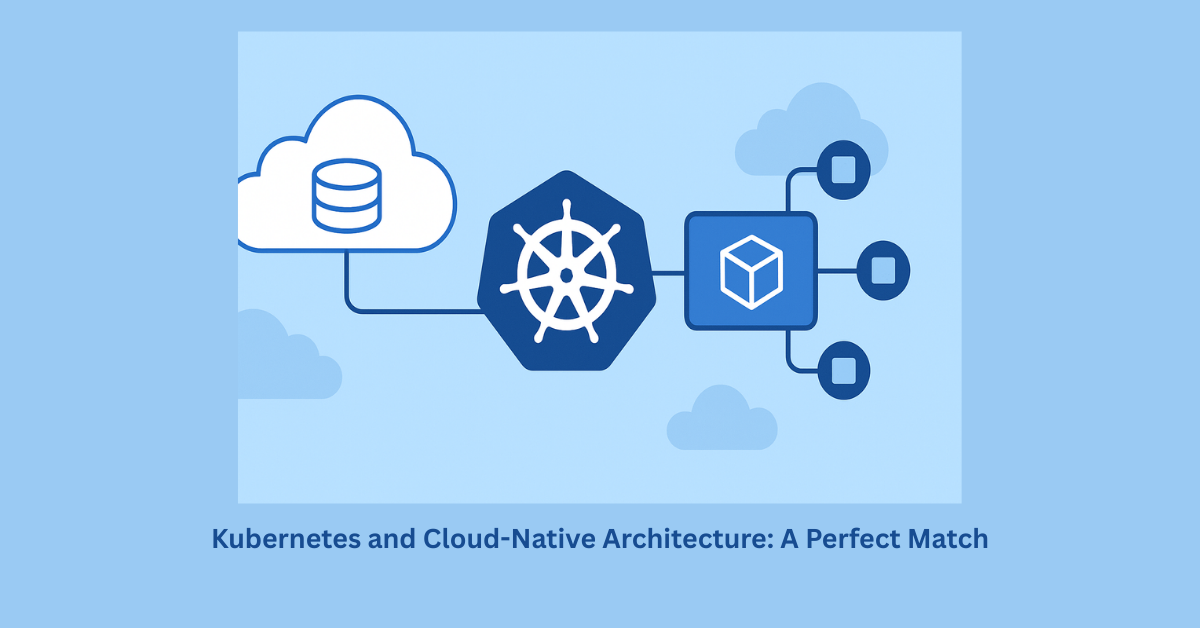
Here’s where the magic occurs. Kubernetes and cloud-native aren’t complementary — they’re joined at the hip. Together, they create the foundation for today’s modern, agile IT environments. Let’s explore why.
1. Scalability on Demand
Traffic unpredictably surges in a cloud-native environment. Picture an online shop on Black Friday. Kubernetes helps make it simple to scale apps up or down automatically based on current demand. That translates into fewer outages, reduced expenses, and satisfied customers.
2. Portability Across Environments
One of the largest IT challenges has ever been the loathed “it works on my machine” issue. With Kubernetes, workloads in containers execute uniformly across public clouds, private clouds, and hybrid environments. Cloud-native applications don’t get stuck in a single environment — providing businesses with freedom and choice.
3. Resilience and Self-Healing
Things fail. But in cloud-native design, downtime is not an option. Kubernetes includes inherent self-healing capabilities. If a container crashes, it automatically restarts. If a server fails, workloads are redistributed elsewhere. This makes business continuity the norm rather than battling fires all the time.
4. Faster Development and Deployment
Cloud-native apps thrive on agile development cycles. Kubernetes supports CI/CD pipelines, making it easier for teams to roll out updates, test new features, and fix bugs quickly. With automated rollbacks, teams can experiment without fear of breaking production.
5. Optimized Resource Utilization
Running applications on Kubernetes ensures hardware resources aren’t wasted. It intelligently schedules workloads to maximize efficiency, which translates into lower infrastructure costs and greener operations.
Real-World Instances of Kubernetes in Cloud-Native Success
This isn’t abstract — a lot of multinational companies depend on Kubernetes and cloud-native architecture for mission-critical workloads.
- Spotify: Operates its huge music-streaming services based on microservices within Kubernetes. This allows them to provide smooth playback to millions of customers at the same time.
- Airbnb: Employs Kubernetes for handling scaling issues when there is high travel demand.
- Banking & FinTech: New banks use Kubernetes-based platforms to make real-time transactions never miss a beat, no matter how intense the loads.
These scenarios illustrate one reality: Kubernetes is not only for hyperscalers. It’s also within reach for startups and mid-sized companies, thanks to cloud providers making managed Kubernetes services available (such as Amazon EKS, Google GKE, and Azure AKS).
Navigate Challenges in the Kubernetes-Cloud-Native Journey
Naturally, embracing Kubernetes and cloud-native architecture isn’t plug-and-play. Numerous organizations struggle with issues such as:
Complexity: It takes experienced teams to configure and operate clusters with ease.
Security issues: The more microservices and containers, the more endpoints to protect.
Cultural transformation: Switching to cloud-native typically requires workflow, collaboration, and even corporate culture adjustments.
The silver lining? With DevOps best practices, automation software, and managed Kubernetes services, these barriers are easily overcome. Most companies begin small — containerizing one app — and then grow incrementally.
The Future of Cloud-Native with Kubernetes
In the future, the interplay between Kubernetes and cloud-native architecture is only going to intensify. Some of the upcoming trends include:
- AI and machine learning on Kubernetes: Data-intensive workloads are being containerized for scalability.
- Serverless + Kubernetes: A marriage that streamlines operations but provides more autonomy to developers.
- Multi-cloud strategies: Kubernetes enables companies to use the best of AWS, Azure, and GCP in parallel, eliminating vendor lock-in.
With more companies adopting digital transformation, Kubernetes will be the foundation of this next-generation cloud-native computing.
Conclusion:
At its core, Kubernetes and cloud-native architecture represent more than just technology — they embody a new way of thinking about building and running applications. Together, they empower businesses to move faster, scale smarter, and innovate without limits.
Whether you’re running a global enterprise or an ambitious startup, adopting this duo could be the key to unlocking agility, resilience, and long-term success in a cloud-driven world.
The ideal combination? Yes. Kubernetes and cloud-native aren’t building the IT future — they are the future.